Followers

Powered By Blogger

Siyaram Freelancers

We take all types of websites development and graphic design projects all over the world. we are the professional freelancers in the IT Industries. The Clients can contact us fsiyaram@gmail.com

The Every Thing by (Famousstar)

People Loves to Read Total Count

Download Our Apps

Wednesday, 19 July 2017

Custom Website Design vs. Website Templates


Custom Website Design vs. Website Templates

There are 2 basic ways that of building a website:
By employing a web site Templates.By hiring somebody to form a Custom web site style.There are pluses and minuses to every technique, and it is vital to know them, therefore, you'll be able to opt for the choice that is progressing to best meet your business's desires and budget.

When it involves making an internet presence for your business, we tend to continuously like Custom web site style instead of web site Templates.Most of the online style work we do is in WordPress and it's a typical question, "What is that the distinction between a web site Templates and a Custom web site Design?"

What Is Custom web site style?

A Custom-Website-Design is developed from scratch as per style font of read -- the data design or direction structure, graphics, functions, and every one designed supported your distinctive specifications.

What Is web site Templates?

A Website Templates could be a web site whose layout and cryptography is already done. it'll offer you some completely different layout, you have got to customise your web site content mistreatment those layout.

How do i do know if a Custom web site style is true for me?

Strict expectations for complete price.The goal could be a really distinctive expertise.Willing to get hold of attention and support needs a decent deal of customization.Ready to pay the additional time to induce it right.You don't need to affect templates or the restrictions they impose you would like your own the web site and move it or manipulate it within the future once ought to i exploit web site Templates?

A restricted budget.You want to maneuver quickly.Willing to grant up some flexibility.You perceive there could also be limitations as you grow which does not trouble you.You have associate in house designer customization isn't a giant focus, therefore, Custom web site style isn't for everybody. As a result, even supposing the founder was fascinated by operating with USA, our custom approach didn't match up together with his size or budget. So, before you would like the method to create certain regarding your selection.

By Mr.Narayan Prajapati 

Sunday, 16 July 2017

The smartphone is eventually going to die, and Apple, Google, Microsoft, and Facebook are racing to kill it


The smartphone is eventually going to die, and Apple, Google, Microsoft, and Facebook are racing to kill it

FILE PHOTO: A customer views the new iPhone 7 smartphone inside an Apple Inc. store in Los Angeles, California, U.S., September 16, 2016. REUTERS/Lucy Nicholson/File Photo
Thomson Reuters
These are the quiet times.
From April to June, tech's biggest companies all held their annual mega-events, laying out their grand visions for the next 12 months or so. 
Facebook kicked it off in late April with its F8 conference, followed by Microsoft Build, then the Google I/O conference, and Apple's Worldwide Developers Conference finished things off. Amazon doesn't really hold events, but it unveiled two new Amazon Echo smart speakers during that period for good measure.
And things will get exciting again, sooner than you know it. This Fall, Apple is expected to reveal a 10th-anniversary iPhone, Google will likely reveal a revamped Pixel smartphone, and Microsoft is expected to hold another one of its regular late-October Surface computer press conferences.
In the meantime, there's not much to do but reflect on what we've learned so far this year about the future of tech. And beyond the hype and the hyperbole, we're starting to see the very earliest stages of a battle for the next phase of computing.
Because while Apple and Google may dominate the smartphone market today, technologies like augmented reality present whole-new platforms where there's no clear winner. So Amazon, Microsoft, and Facebook, having missed out on owning a mobile platform, are doing their damndest to hasten the end of the smartphone — and the end of Apple and Google's duopoly, while they're at it.
Skin in the game
Every major technological shift has created big opportunities for the few entrepreneurs who see it coming early — in the seventies, Apple and Microsoft made big bets that the PC would be a much bigger market than gigantic room-sized mainframes, while the mainframe industry decried the PC itself as a fad. We see who won that one.
Similarly, Microsoft didn't fully realize the potential of smartphones, until well after Google and Apple proved them wrong. Now, Google's Android is the most popular operating system in the world, full stop. And the iPhone has propelled Apple to record profits and to the status as the company to beat in tech.
Well, it seems like time is a flat circle. Right now, we're seeing the earliest growing pains of augmented reality and virtual reality — tech that overlays the digital world onto our human senses. It means information, projected into your eyes and ears, as you need it. Why carry a phone when Netflix and WhatsApp are floating in front of you?
Some call it a fad, or just something that's too new and untested to be considered a real threat to the smartphone. And yet, there's a veritable arms race to build these augmented reality platforms of the future.
Amazon's Alexa is primarily thought of as a digital voice assistant, but having a virtual "person" tell you the time and weather definitely qualifies as augmented reality. Microsoft has its reality-bending HoloLens "hologram" goggles. Facebook and Snapchat have both built augmented reality straight into the camera. Even Google-backed startup Magic Leap thinks its yet-to-released goggles have a shot at becoming a new platform.
The net result is a race to build whatever is going to do the smartphone what the PC did to the mainframe. What these companies all have in common is that they missed the boat on building smartphone operating systems of their own. Now, it's on them to build whatever comes next.
Defensive position
Apple and Google are well aware of the threat and are not standing still.
Apple has ARkit, a system for building augmented reality into iPhone apps, using the phone's built-in camera. It's technologically robust enough and easy enough to use that developers love it, giving Apple a nice foothold in augmented reality. If and when Apple releases smart glasses, those apps will come right over.
Google has various augmented reality efforts in the works, including Project Tango. And although the first version of the Google Glass headset flopped, if Google figures out how to revamp the device, it will have a vehicle to extend Android into the AR realm. 
Microsoft HoloLensMicrosoft's HoloLens goggles project three-dimensional imagery into your field of view. Microsoft
In a weird way, going on the defensive like this almost gives Apple a perverse incentive to replace the iPhone: If Apple can build the next great hardware platform itself, it means that Amazon can't do it with Alexa, and Microsoft can't do it with HoloLens. 
In the meantime, as we appreciate all the new hardware and software goodies coming out later this year, keep the perspective that everything we're seeing now is the first salvo in a computing war that will rage for the next decade and beyond.

Useful Tips to Design a Website Homepage That Draws Visitors


Useful Tips to Design a Website Homepage That Draws Visitors

Growing a website in your employer, company or agency is a totally beneficial way to advertise and inform the users and people what your product or employer is ready. however greater crucial than this is making the people truly live to your internet site to examine up about it. You want to make your internet site’s homepage “stand out” and enchantment to the user because as they are saying, the primary impact is the final impact. human beings generally have a tendency to presume mind simply as they see the web page once they open your website’s link. here.

You may be interested in the following related articles as well.
What Should be on Your Website Homepage
Your website site’s homepage ought to comprise information that is clean and to the point. maximum critical homepage have to comply with the brand new trends. There shouldn’t be useless statistics that bores the consumer or information that is inappropriate to the purpose of the internet site. all the records need to be prepared smartly, ideally in paragraphs to make it less complicated and relaxed for the consumer to study and method the statistics. In case of advertising a products or services, use photos and videos that give the person a higher concept of what your services or products is about and what it gives.

Designing an Ideal Navigation Menu
Use an clean navigational homepage that allows the person to easily get right of entry to all different pages related to your website. Don’t muddle all of the tabs and hyperlinks that confuse the user. hyperlinks for the subsequent and former web page ought to be at the start of your page to be able to assist the consumer navigate thru the whole website without difficulty. add in not unusual links that link the present day web page to essential pages consisting of the house page or the contact web page. Make the hyperlinks in words as opposed to icons that help the user have a better idea of what page he/she is establishing.

Principles Of Good Homepage Design
Make your information alluring and engaging. Utilize hues, topics, and text styles in your landing page and every other page. Utilize distinctive textual styles for various arrangements of data, not each time you change a passage or sentence. You can even utilize diverse content sizes, yet simply like utilizing the textual style, don't escape. What's more, don't utilize excessively expansive content that has the client looking over your site page more often than not. Utilize basic hues for content and comparable foundation topic that includes an alluring look to the entire page. The most ideal blend is highly contrasting in light of the fact that it is simpler for the client to peruse. Try not to utilize excessively numerous hues; it would just make the landing page unappealing.

Collect all the data that is effectively and open and don't escape in making your landing page "excessively favor". Make it straightforward and clear. Individuals are effortlessly occupied, given them a chance to focus on one thing at any given moment and process all the applicable data legitimately instead of simply discarding in all the data.

Make Your Homepage Load Faster
Remember that users area unit continually during a hurry and need the knowledge quickly. Don’t create your website’s homepage too “heavily” crammed with graphics, footage and videos etc. that create the homepage take longer to load. to create your site’s homepage load quicker use a lot of text and fewer graphic material like footage, animations and videos. If graphic material is absolutely necessary on your homepage, use graphical software system that may alter or optimize the resolution or size of you graphic material and facilitate your web site load quicker. though many folks have quick net connections however not all of them and perhaps not those your web site is attempting to draw in. therefore it’s preferred to create your website quick loading in any case.

Popup Ads Should Avoid at Homepage
Don’t use pop up ads on your homepage and don’t go attempting to “over sell” your product exploitation them through different websites and pages. crop up ads ar links and windows that open mechanically after you click on a link or tab that will not are meant for that crop up. although these crop up ads ar used as ways in which to extend a product’s advertising and in some cases ar effective, however they're being employed quite necessary and have created several net users irritated and aggravated. associate degree irritated user is extremely unlikely to come back to your web site if he’s been managing crop up ads of your product quite needed. And if you set a lot of and a lot of crop up ads on your homepage, it might simply distract and devil your users and maybe even resist them for longing your own web site.

Manage Links and Forms at Homepage
In the case of advertising and marketing a product of your company through your web site, it’s a decent plan to incorporate links like purchase, sell, shipping, ordering choices, and client feedback, and the other info which will facilitate the user to be totally tuned in to what he’s shopping for. Don’t jumble up all the knowledge on your homepage, rather established links wherever the user will well navigate through all the knowledge.

Conclusion
In the end, keep the aim of your web site in mind. does one wish to advertise your product? does one wish to supply on-line searching service? does one wish your audience to easily scan and discuss concerning your blogs and articles? Keeping your objectives in mind can assist you work additional effectively and can assist you produce a far better homepage for your web site.


Friday, 14 July 2017

How to Use SEMrush to Make a Keyword Research Faster


How to Use SEMrush to Make a Keyword Research Faster

No ratings yet.
Are you using SEMrush?
If you’re not, you’re missing on numerous PPC and SEO opportunities to increase traffic and sales, and lead conversion!
Even if you are, you might have a look at the following guide on how to use to make your keyword research perfect.
This article will help you to take advantage of this useful function of SEMrush and make it your competitive advantage.

How to use SEMrush for researching keywords
semsush
semsush
The opportunities for marketers to perform a comprehensive keyword research have been significantly limited by Google recently. The company updated it super popular Keyword Planner tool and the users found that it produced less data than before.
The even caused a negative response from the users. Some of them wrote that the explanations given by Google were nothing but confusing while others blamed the company for limiting the amount of data available for use.
Anyway, marketers needed to find another tool to replace or use alongside Google’s Keyword Planner. Many of them found SEMrush, a powerful software suite for online marketing, from SEO and PPC to social media and video advertising research.
Keyword research using this tool is anything but difficult. To start, the users need to enter keywords into the search box in the top-left corner of the window.
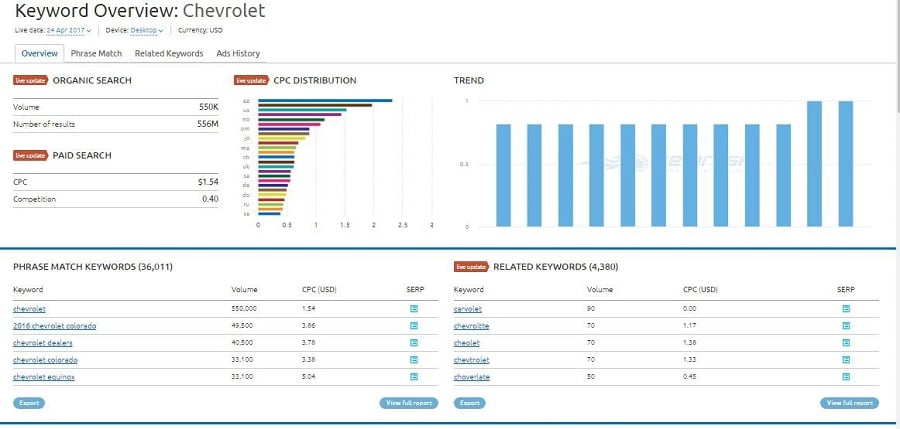
Let’s try to use “Chevrolet” as the keyword. The results are the following.
The screenshot showed an overview of the search, including Organic Search, Paid Search, Trend, CPC Distribution, Related Keywords, Phrase Match Keywords, Organic Search Results, and even more.
Detailed reports on all these indicators can be obtained within seconds by clicking on corresponding buttons (however, some of the data in detailed reports is hidden and should be unlocked by signing up for a free 7-day trial of the Pro version).

How to perform competitive keyword research
semrush
semrush
  • Step 1. Gather competitors’ data
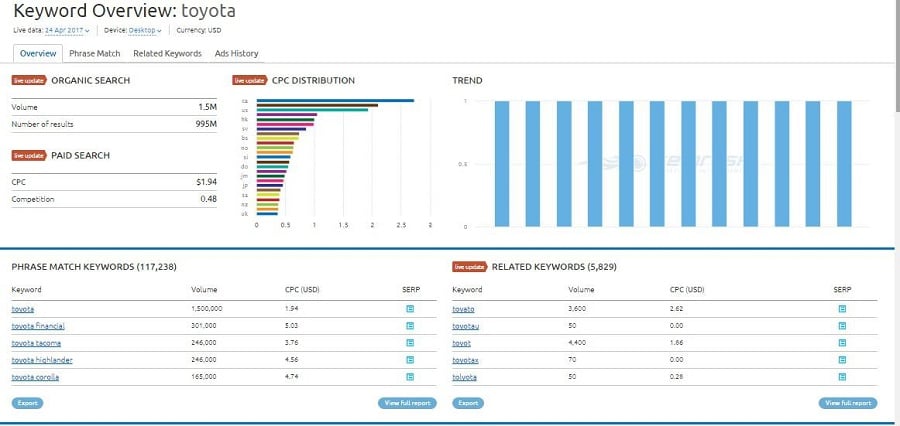
  • Now, when we identified competitors of Chevrolet, we have to start the competitive research by entering each of them in the search box and finding out their positioning in the search. By doing this, we are able to determine all keywords of competitors.
    Here’s what we’ve got.
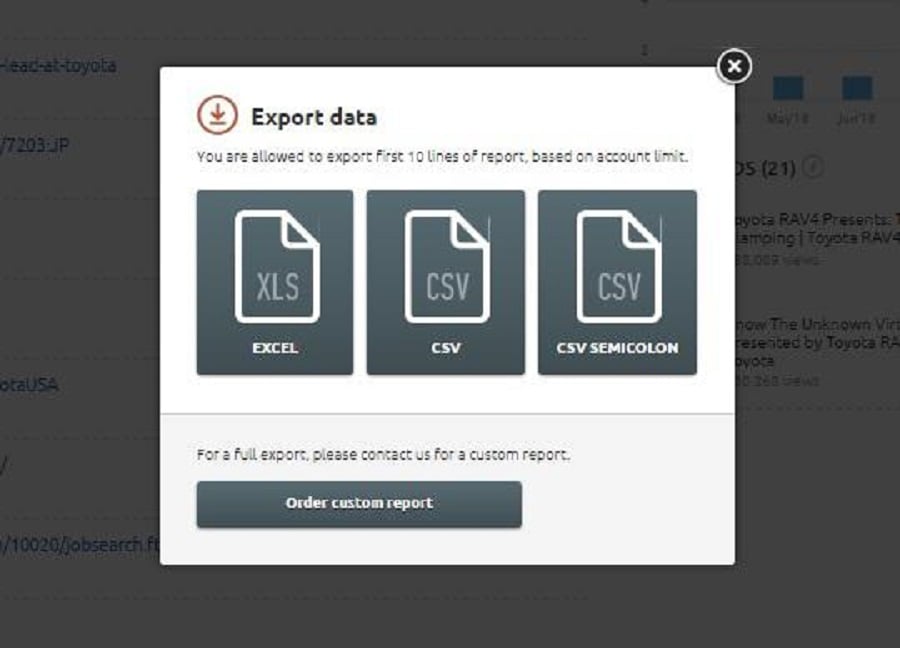
    To ensure the reliability of the data, SEMrush allows eliminating irrelevant items by using various filters before the export. For those who need to export the final data in Excel, this is an incredible function because it is much easier and faster in the tool’s environment.
    The export button can be found below the report on the web page of SEMrush. It offers three options for exporting the data, as shown on the next screenshot.
    Once we have the competitors’ data identified, a cleaning process can begin. It means that the keywords that are not associated with the actual competitor can be deleted because they are irrelevant. The ones that meet this requirement should be copied into one list for further analysis.
  • Step 3. Grouping and Categorizing
  • These two processes need to be performed only on relevant keywords: the results are grouped together to create topics. For example, some of the Toyota’s and Mitsubishi’s models are SUVs and sedans, so correspondent groups of keywords can be established (“Toyota SUV,” “Mitsubishi sedans” etc.).
    Then, the analysis shifts to the comparison of the search results. For example, if you see both “Toyota cars” and “Toyota sedans,” the need to be in the same group because “cars” and “sedans” are basically the same thing. Use Google for help you here.
  • Step 4. Construction of a competitive keyword table
  • Now, you need to organize the search volume for each term and ranking. By using V lookups, a table can be built to present this data in Microsoft Excel. To improve the understanding of the volume of a particular topic, you can use the “sumif” function.
    It sums the values in a range that meet specified criteria, so it’s perfect for summing up all keyword volumes related to a group.
  • Step 5. Analysis of opportunities
  • This step aims to determine the keyword phrases that need to be pursued. To achieve that, the rankings of Chevrolet’s competitors and the search volume identified in the previous step can be combined with the information about the product (in this case, vehicles).
    By filtering the ranks to show blanks, one can view unused keywords. They should be considered as ones to pursue because no one is using them. We have found an opportunity to grow!
    report
    report
    Additional help
    If you need to get to know keyword research more, you can also find these resources helpful:
    WordStream’s Keyword Tool – this tool allows to research particular groups of keywords and provides suggestions on using them by showing competitors, search volume, Google search volume, relative frequency, and other characteristics. The first 30 searches with this tool are completely free.
    Keyword Tool – one of the simplest tools out there, Keyword Tool gives 750+ suggestions for free. It is an extremely reliable option that works even without creating the account, so it’s perfect for a quick search and get immediate results (it’s also used by Forbes, Search Engine Land, Search Engine Watch, and other well-known websites).
    Assignment Helper – are you a content creator or online marketer working in the area of writing? Then you will this tool incredibly helpful. It can be used to find out what potential readers are searching for on Google. Not only it’s a great keyword research tool but also a good brainstormer, as keyword planning specialists will assist you with exploring numerous possibilities for expanding your internet reach. No account is required.
    Ubersuggest – this tool takes keywords and immediately provides you with an impressive list of keywords organized numerically and alphabetically. All data can be exported into Excel and other table editors.
    Google Keyword Planner – this one just cannot be missing from this list. The tool designed by Google is, of course, the most widely used one right now, as it delivers a wide range of helpful stats like competition level, average monthly searches, the average cost per click, and more. To use it, however, you must sign up for an AdWords account.
    The Bottom Line
    Don’t miss the opportunities to increase traffic and sales, use tools like SEMrush to advance your online business! Every internet search is an expression of desires, needs, wants, and interests of potential customers and leads, so your business would benefit greatly if you meet them.

    Here Are the Research Hacks I Use to Come up with a List of Target Keywords Fast


    Here Are the Research Hacks I Use to Come up with a List of Target Keywords Fast

    Keyword research is synonymous with SEO.
    I remember, back in the day, when keyword research was SEO.
    The recipe was simple.
    Use the Google Keyword Tool (now known as the Google Keyword Planner) to type in a broad search phrase.
    Find a keyword phrase that receives a considerable number of searches with minimal competition.
    Stuff the crap out of it in your blog post.
    And voila! You’re on the first page of Google!
    That was when SEO was pretty archaic and Google’s algorithm was much less sophisticated than it is today.
    Back then, pretty much anyone could game the system with a little know-how.
    Heck, I remember when people would actually “spin articles” and get solid rankings by keyword stuffing.
    But Google obviously stamped that out with major algorithm updates like Penguin and Panda.
    Nowadays, keyword research is a bit more complex, but many of the same principles still apply.
    Over the years, I’ve come up with quite a few research hacks that help me come up with a list of keywords in a hurry.
    In this post, I’ll point out some of my favorites that you can also implement.
    Use Ubersuggest
    This is a tool that’s not on everyone’s radar but is great for quickly amassing a list of potential keywords.
    Here’s a screenshot of the tool’s description:
    Let me say that it’s not as robust as the Google Keyword Planner, but it does offer a few different features I love.
    Using it is simple.
    From the Ubersuggest homepage, enter a broad keyword.
    I’ll use “3D printer” as an example.
    Here’s what pops up:
    Just like that, I have 361 different keyword ideas!
    If you want, you can copy and paste some or all of these keywords into a file, spreadsheet, etc.
    Just click on “View as text.”
    Then you’ll see this:
    This is a lightning-fast way to generate a huge list of keywords.
    From there, you can pick and choose the ones you want to target.
    But let’s say you want to expand on a particular keyword to come up with even more ideas.
    Click on it:
    Then click “Expand this keyword.”
    You’ll then get another list of keywords based on the one you clicked on:
    For this particular search, I got 217 additional keywords.
    Another cool feature is that you can gauge interest in a particular keyword by seeing how it’s performing on Google Trends.
    Just click on the keyword:
    Then click on Google Trends:
    From there, you can get a pretty good idea of whether it’s trending up, trending down or just neutral.
    But wait, there’s more!
    Ubersuggest has another feature, called “Word Cloud,” that will show you additional keywords frequently used along with the keyword you’re searching for.
    From the top of the page, click on “Word Cloud.”
    Here are the results I got:
    The larger the word, the more searches the keyword phrase has received.
    I love visuals, so this is an intuitive way for me to get keyword ideas without much work.
    The only drawback of Ubersuggest is you can’t see the number of monthly searches a keyword receives or the competition level and suggested bid.
    But you can always plug whatever keyword you’re interested in into the Google Keyword Planner.
    Nonetheless, it’s a great tool for generating a big list of target keywords fast and has some great features that provide you with valuable intel.
    Use BuzzSumo
    Let me just say I love BuzzSumo!
    It’s hands down one of the best tools for generating new content ideas, seeing how popular a topic is and even for finding influencers to reach out to.
    But you can use it for keyword research as well.
    Here’s what you do.
    Type in your broad keyword:
    You’ll get a list of content that includes that keyword.
    Here are a few of the results I got for “3D printer.” There were 882 results in total:
    Now what you want to do is scan through the results and look for other keywords paired with your broad keyword.
    Here are a couple of examples:
    What I love about this technique is that I can tell how much interest there is in a particular keyword by simply looking at the amount of engagement the content has received.
    For instance, the second keyword I highlighted—“ultra high-def 3D printer”—had 13.9k shares.
    Of course, interest may have been piqued because the piece was about creating futuristic death masks, but there’s obviously some interest there.
    I suggest browsing through the list and copying and pasting the keywords that catch your attention and are getting some buzz.
    You can also get a few additional ideas by scrolling to the bottom of the page and checking out “Related Searches.”
    Just click on a particular search phrase and repeat the same steps.
    Use Google’s auto-complete feature
    Google is the ultimate enabler for lazy people.
    We don’t even have to type out our full search inquiry anymore.
    Just type in a few characters, and Google will auto-complete your inquiry based on popular searches.
    I use this all the time.
    It also happens to be perfect for getting instant keyword ideas.
    Here’s what pops up when I search for “affiliate marketing”:
    Now, I realize this doesn’t give you a massive list of keyword ideas, but you can bet there’s a high level of interest for almost anything that pops up.
    For something to appear on auto-complete, it obviously has to receive a high volume of searches.
    You can also do this on Quora as well:
    Check out related searches
    Here’s another easy way to extract even more info from Google.
    Enter a broad keyword phrase, and scroll to the very bottom.
    You’ll see a section called “Searches related to [your keyword phrase].”
    That right there will instantly give you eight keyword ideas.
    But you can get more by clicking on an individual keyword phrase:
    After scrolling down to the bottom again, here’s what I got:
    You can go on infinitely to get as many ideas as you need.
    Just follow the same sequence of steps.
    FYI, you can do this on Bing as well.
    “Soovle it”
    If you’ve never heard of Soovle, it’s a sweet little tool that will give you keyword suggestions from popular sites like Google, Wikipedia, Amazon, Bing, etc.
    And it’s incredibly easy to use.
    Just type in your keyword into the search box:
    Within seconds, the page will be populated with keyword ideas from each of these sites:
    It’s pretty awesome.
    If you want to do some more research, just click on the keyword you’re interested in.
    I’ll click on “3D printer software” from Bing:
    This will show you the results so you can see what type of content competitors are creating and what’s ranking the best.
    Scrape ideas from Bing ads
    Bing is dwarfed in terms of its user-base when compared to Google.
    It even fell behind the Chinese search engine, Baidu, recently.
    That little red sliver of the pie chart is Bing’s search engine market share in 2017.
    A mere 7.31%.
    But who cares?
    It serves multiple purposes from a marketing standpoint.
    One is coming up with target keywords.
    This hack I came up with is actually based on one of Brian Dean’s tactics for finding keywords for titles and description tags.
    In his post, Brian talks about how you can scan through copy of Google AdWords ads to find potential titles and tags.
    The only issue with this is that AdWords doesn’t always have an abundance of text-based ads.
    See what I mean?
    But look at what I get when I enter the same search phrase in Bing:
    And that’s just part of it.
    Scroll down to the bottom, and I get even more text-based ads:
    All I have to do is look for keyword phrases.
    Here are a few potential ideas:
    Now, I’m not saying jam-packing ads like this into search results translates into a great user experience, but it’s perfect for coming up with target keywords.
    And keep in mind that companies are funneling a considerable amount of time and money into these ads, which means they’ve done their keyword research.
    Capitalize on their work, and you’re likely to get favorable results.
    Conclusion
    Keyword research has changed quite a bit over the past five or so years.
    And it’s definitely become more sophisticated.
    But at the end of the day, it still revolves around the same concept, and it doesn’t need to be unnecessarily difficult.
    What I love is the increased number of tools available today.
    You’re not limited to using only the Google Keyword Planner.
    Don’t get me wrong. It’s great and all.
    But everyone is using it, including your competitors.
    So it’s best to come up with different, less common, approaches.
    The research hacks I discussed here are all effective for unearthing keyword ideas and will help you create a list quickly and easily.
    Using them should also give you an edge because most of your competitors aren’t aware of these tactics.
    It’ll put you ahead of the game and will keep you supplied with high-quality keywords.
    How big of a role does keyword research play in your SEO strategy?